



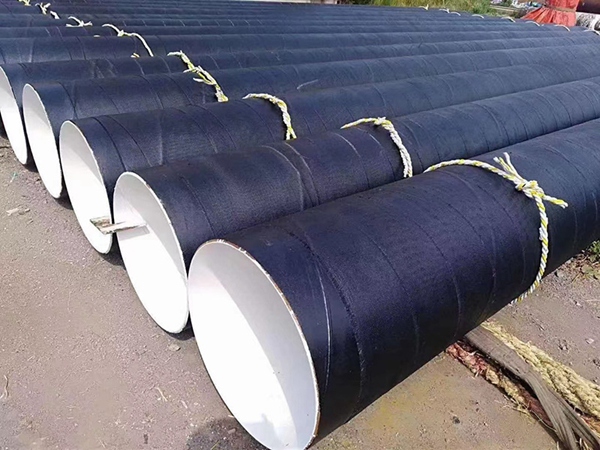
Epoxy Coal Tar Anti-Corrosion Steel Pipe
Epoxy coal tar coated anti-corrosion steel pipe supplied by Cangzhou Jinyang Pipeline Manufacturing Co., Ltd. for buried steel pipelines in soil and moist environments....
1) Confirm burial depth, soil aggressiveness and application temperature, and choose a formulation suited to low temperature where needed; 2) Select the number of coats from the design (three coats two wraps, four coats three wraps, etc.); 3) Glass-cloth overlap and wrap tension affect overall strength; 4) Field joints and reserved pipe ends need the same treatment.
| Parameter | Details |
|---|---|
| Reference standards | GB/T 23257, SY/T 0413, DIN 30670, CAN/CSA Z245.20, SY/T 0447, CECS 10, ISO 4179 |
| Diameter range | DN200–DN3800 |
| Coating systems | 3PE, 2PE, TPEP, PEEP, FBE, 2FBE, epoxy coal tar, IPN8710, cement mortar lining |
| Surface preparation | Sa 2.5 with specified anchor profile |
| Base pipe | SSAW, ERW/JCOE and seamless pipe |
| Inspection | Coating thickness, peel/adhesion, holiday test, impact, bending |
Epoxy coal tar coating combines coal tar epoxy with glass cloth reinforcement, forming a layered coating-glass-coating structure. Common builds include three coats with two wraps and four coats with three wraps, balancing water resistance and mechanical strength.
It suits parts of buried municipal water and drainage works, heating outer pipes and repair or field-joint work. Compared with 3PE, quality depends more on site conditions and workmanship, which makes it practical for fittings, joints and rehabilitation where factory coating is difficult.
Surface preparation, mix ratio and intercoat interval are the critical points: blast grade, ambient temperature and humidity all affect film quality. After completion the total thickness, appearance and holiday test are checked, with adhesion sampling where the design requires it.